Reading the Rule of 40 and CAC payback together.
Growth and burn are a single trade-off, not two metrics. Reading the Rule of 40 and CAC payback together shows whether the efficiency your board demands is real or borrowed from next quarter.
TOOLS & TECH — MAY 12, 2026 —
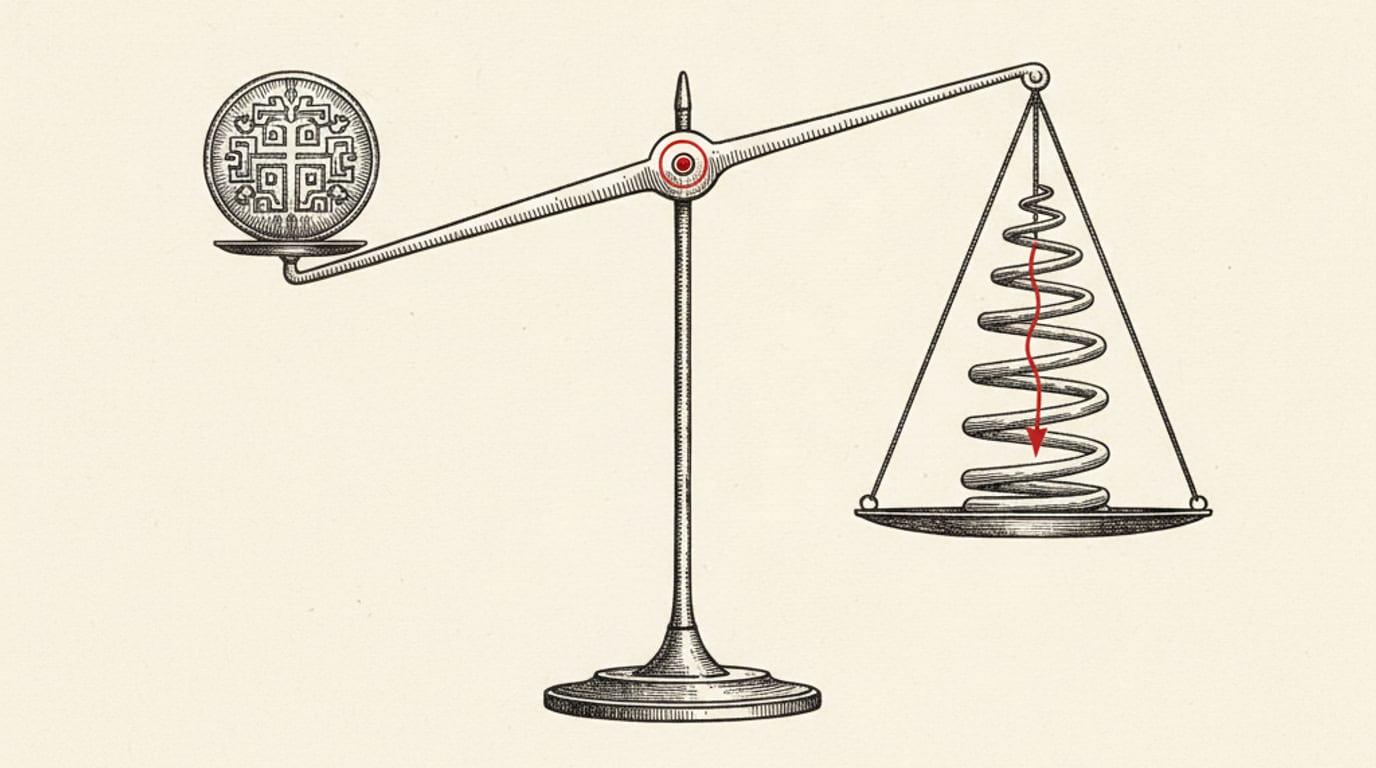
The Rule of 40 became boardroom shorthand for a reason: it collapses the growth-versus-profitability argument into one number a director can hold in their head. Add revenue growth rate to free-cash-flow margin; clear 40 and the business is judged to be trading growth and burn in a defensible ratio. But the number is a summary, not a diagnosis. Reading the Rule of 40 and CAC payback together is what tells a finance leader whether the efficiency their board is applauding is real or borrowed from next quarter's cohorts.
The distinction matters because the two metrics fail in opposite directions, and a company can look healthy on one while quietly breaking on the other.
What the Rule of 40 actually measures
The rule is a trade-off, stated plainly: a company growing 60% can afford to burn 20 points of margin; a company growing 15% needs to be generating 25 points of FCF margin to earn the same score. Bessemer Venture Partners popularized the framing in its State of the Cloud work, and the benchmark has held up as a rough sorting line.
Rough is the operative word. Depending on the dataset and the year, only about a third of software companies clear 40 in any given period. Bain & Company's analysis puts the share that consistently sustain it lower still. Clearing it once is common; clearing it across cohorts is rare.
The weakness is that the rule says nothing about how the growth was purchased. A company can post 45 on the strength of a sales-and-marketing budget that will not pay back for two years. On the quarterly slide, that reads as discipline. In the cash account, it reads as a loan.
Where CAC payback exposes the borrowed number
CAC payback answers the question the Rule of 40 ignores: how many months of gross margin does it take to earn back the cost of acquiring a customer. The healthy band for growth-stage SaaS runs roughly 12 to 18 months; past 18, the acquisition economics are stretched, and past 24 they are usually indefensible. OpenView's SaaS benchmarks tracked the median drifting north as companies chased growth into 2022, then correcting as capital tightened.
Pair the two and the picture sharpens. A 42 on the Rule of 40 with a 14-month payback is a business converting spend into durable revenue. A 42 with a 26-month payback is the same headline number resting on cohorts that have not yet — and may never — pay for themselves. The efficiency is not real; it is timing.
This is why CAC payback belongs among the metrics a finance leader should own outright rather than delegated to the growth team. It is where the marketing budget and the cash forecast meet.
Add the burn multiple, then read all three
The third instrument is the burn multiple — net burn divided by net new ARR — which David Sacks defined and wrote up on his blog as the "single most important" efficiency metric. Under 1x is elite; over 2x signals a company buying growth expensively.
Read together, the three cover different failure modes. The Rule of 40 grades the growth-profit trade. CAC payback grades the durability of the acquisition engine. The burn multiple grades how much cash it takes to add a dollar of ARR. A company can pass one and fail the others, and the divergence is the signal.
Note that the ARR feeding all three is itself a constructed number. As covered in why ARR and recognized revenue never tie out, the annualized run-rate a growth team reports and the revenue GAAP recognizes rarely agree — so the burn multiple's denominator deserves the same scrutiny as its numerator.
The diligence lens
A Series A partner or a PE buyer does not read the Rule of 40 in isolation, and neither should the operator. The SaaS Capital diligence pattern is consistent: layer the score against payback and burn, then decompose the growth. Is it net expansion or new logos? Retention health — the floor and the engine of gross versus net revenue retention — determines whether a strong Rule of 40 survives contact with the renewal cycle. A 45 propped up by discounted first-year deals that churn at renewal is a different asset than a 40 built on 120% net retention.
The buyer's question is always the same: is the efficiency structural, or was it manufactured in the quarter being sold? Three ratios read together answer it. One ratio, read alone, invites the manufactured version. The rebuild the answer demands is less a data problem than an operations one — the process discipline that keeps spend, cohorts, and renewals reconciled between board meetings.
Why the quarterly dashboard reports a business that no longer exists
Here is the failure that undoes the whole exercise. All three ratios move monthly. CAC payback shifts as spend changes and as cohorts mature — a payback figure calculated on a cohort that is three months old is a projection, not a fact. Burn multiple moves with every hiring decision. The Rule of 40 recombines both.
A static quarterly dashboard freezes this on the day it was pulled. By the time the board deck circulates, the sales team has raised spend, a cohort has aged, and a renewal batch has landed. The slide reports a version of the business that no longer exists.
The value is not in the snapshot. It is in watching the trade-off move as decisions land — seeing payback lengthen the week a new channel is turned on, seeing the burn multiple respond before the quarter closes. That is a visibility problem before it is a metrics problem, and it is why finance teams increasingly wire these ratios to live data rather than recompute them monthly by hand. Tools built for that — from Mosaic and Drivetrain to platforms that recompute the trade-off as spend and cohorts move — exist because the quarterly cadence stopped matching the speed of the decisions.
Read the three together, and read them while they are still true. ■
More in this series
- The seven SaaS metrics a finance leader should own outright.
- Why ARR and recognized revenue never tie out.
- Reading the Rule of 40 and CAC payback together.
- Gross vs net revenue retention: the floor and the engine.
The Briefing
One email a week. No filler. No fluff.
Read by CFOs, founders, and finance operators at high-growth companies.
Continue reading

REVENUE
Why ARR and recognized revenue never tie out.
The board deck says one number, the income statement says a lower one, and the CEO wants to know who is wrong. Neither is: here is why ARR and recognized revenue never tie out, and the bridge that explains the gap instead of chasing it.
The Hiring Ledger
Headcount Planning That Protects Runway, Not Just Records Hires
A CFO-level framework for headcount planning that protects runway by tying every approved role to fully-burdened cost, ramp, and a specific revenue driver before the offer goes out.

Cadence
De-Risking the Board Meeting Before It Starts
A four-week prep cadence for de-risking the board meeting before it starts, so tough numbers get socialized one-on-one and no director sees a red metric for the first time in the room.